


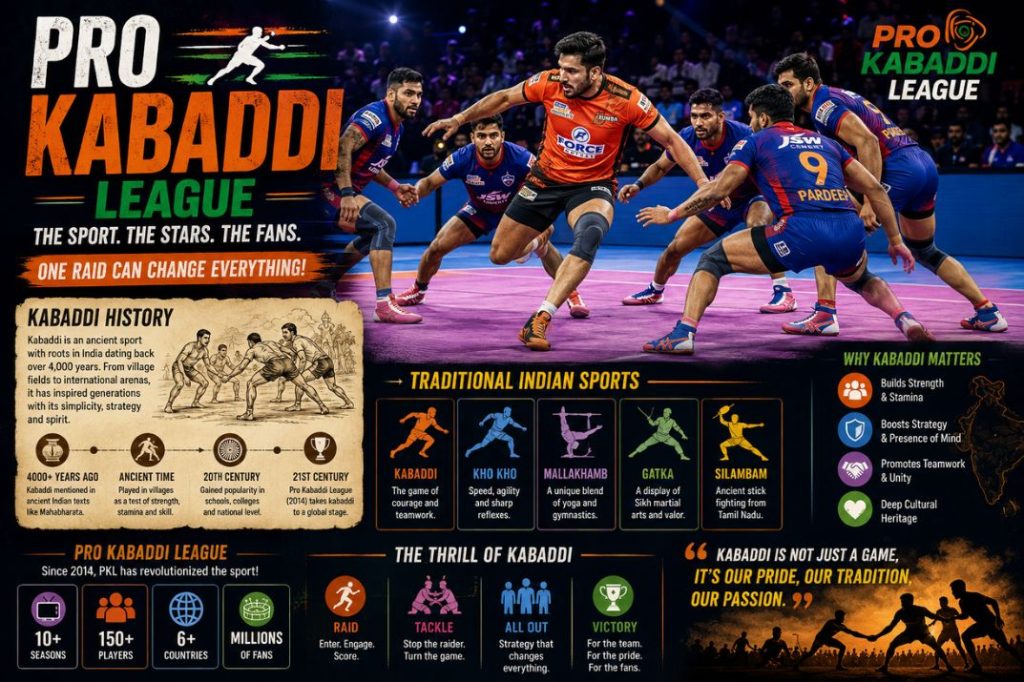
Kabaddi has a history that reaches far beyond modern stadiums, television broadcasts and professional contracts. For generations, the sport was played in villages, schools and local communities across India and the wider South Asian region.
Today, however, kabaddi looks very different.
The arrival of the Pro Kabaddi League transformed the sport into a professionally organised competition with major venues, television coverage, international players and a large fan base.
This transformation is an important part of the wider story of traditional Indian sports. It shows how an old sporting tradition can adapt to modern audiences without completely losing its original identity.
To understand the popularity of the Pro Kabaddi League, it is useful to first understand the long and fascinating Kabaddi history behind the game.
The History of Kabaddi
Kabaddi is generally regarded as a traditional South Asian sport with particularly deep roots in India.
Unlike sports that developed around formal clubs and purpose-built facilities, kabaddi grew as a simple physical game that could be played with very little equipment.
Players needed a playing area, teammates and an opponent.
That simplicity helped the sport spread through local communities.
A Game Built Around Strength and Strategy
At its heart, kabaddi combines several physical and mental skills.
A raider enters the opposition’s half and attempts to tag defenders before returning safely to their own side.
The defending team tries to stop the raider.
This creates a fascinating combination of:
- Speed
- Strength
- Balance
- Agility
- Timing
- Breath control
- Tactical decision-making
The basic idea is simple enough for newcomers to understand, but professional kabaddi requires extremely sophisticated tactics.
From Local Fields to Organised Competition
For much of its history, kabaddi was associated with local and regional competition rather than the commercial sporting structure seen today.
That began to change as formal rules and organised tournaments developed.
The sport became increasingly structured, allowing competitions to be held across larger regions and eventually internationally.
India became the central force in the development of modern competitive kabaddi.
Over time, the sport also spread throughout other Asian countries, including Iran, Bangladesh, South Korea and several other nations.
Traditional Indian Sports and Cultural Identity
Kabaddi occupies an interesting position among traditional Indian sports.
Unlike sports introduced during the colonial period or imported from other parts of the world, kabaddi is closely associated with the physical culture of the Indian subcontinent.
Its accessibility also helped it remain connected to ordinary communities.
You do not need expensive equipment to play kabaddi.
That makes it particularly suitable for schools, villages and grassroots programmes.
Why Traditional Sports Still Matter
Traditional sports carry cultural value that goes beyond competition.
They can preserve:
- Local sporting traditions
- Community participation
- Historical practices
- Regional identity
- Indigenous forms of physical activity
The modern development of kabaddi demonstrates that traditional sports do not necessarily have to remain unchanged.
They can evolve while retaining their distinctive character.
The Birth of the Pro Kabaddi League
The Pro Kabaddi League changed the commercial profile of kabaddi in India.
The league began in 2014 with an ambitious idea: take a familiar traditional sport and present it through a modern professional sporting model.
The approach borrowed elements that audiences had already become familiar with through professional leagues in other sports.
Teams received distinctive identities, players became recognisable stars, matches were professionally produced, and the competition was packaged for television audiences.
The result was a dramatic increase in attention around kabaddi.
How the Pro Kabaddi League Changed the Sport
Before the league, many people knew kabaddi primarily as a traditional or school-level sport.
The professional league introduced it to a much broader entertainment audience.
Matches became more accessible through television and digital platforms, while professional teams created new local fan bases.
The Rise of Kabaddi Stars
One of the biggest changes was the emergence of professional kabaddi players as sporting celebrities.
Raiders and defenders began developing individual reputations.
Players such as Anup Kumar, Rahul Chaudhari, Manjeet Chhillar and Pardeep Narwal became widely recognised among kabaddi supporters.
Their success helped demonstrate that kabaddi could provide a professional career rather than simply being a recreational or amateur activity.
Understanding the Modern Kabaddi Game
The modern professional version of kabaddi is much more tactical than a casual viewer might initially expect.
Every raid involves a decision.
Should the raider attempt a quick touch?
Should they target a specific defender?
Should they retreat immediately?
Or should they try to create a larger scoring opportunity?
The defenders face equally important choices.
The Role of the Raider
Raiders are responsible for entering the opposition half and attempting to score points.
A successful raider needs exceptional balance and acceleration.
They also need to read defensive formations quickly.
One wrong movement can leave a raider trapped.
Common Raider Skills
Professional raiders use techniques such as:
- Running hand touches
- Toe touches
- Dubki movements
- Bonus attempts
- Quick retreats
- Sudden changes of direction
The best raiders combine these techniques with excellent timing.
The Importance of Defence
Defence is just as important as attacking play.
A team can have an excellent raider but still struggle if its defenders cannot stop opponents.
Defenders work together to limit the raider’s movement.
Common defensive techniques include:
- Ankle holds
- Thigh holds
- Blocks
- Dash attempts
- Chain tackles
Successful defence requires communication and coordination.
One defender may initiate the tackle while teammates provide support.
Why Kabaddi Works So Well as a Professional Sport
Kabaddi has several characteristics that make it suitable for modern sports entertainment.
Matches are relatively fast-paced.
Scoring opportunities appear regularly.
The action takes place in a confined area, making it easy for spectators and television cameras to follow.
There is also a natural battle between individual skill and team strategy.
A single raid can change the momentum of a match.
The Entertainment Factor
Professional sports audiences want action.
Kabaddi delivers that naturally.
A raid may last only a few seconds, but those seconds can contain several decisions, movements and tactical changes.
This creates repeated moments of tension throughout a match.
The International Growth of Kabaddi
Although India remains the most important country in professional kabaddi, the sport has developed an international presence.
Kabaddi has been played competitively across Asia, and international tournaments have helped introduce the sport to wider audiences.
Iran has become one of India’s strongest rivals in international men’s kabaddi.
Bangladesh, South Korea, Pakistan and other countries have also developed national teams and domestic programmes.
This international development gives kabaddi an opportunity to move beyond its traditional geographical base.
Kabaddi’s Olympic Ambition
One of the long-term ambitions surrounding kabaddi is Olympic recognition.
For that to happen, the sport needs strong international participation, consistent governance and broader geographic development.
The growth of professional leagues can help by creating better players, coaches and infrastructure.
However, commercial success in one country alone is not enough to make a sport truly global.
Kabaddi’s next challenge is developing sustainable participation across more countries.
The Future of the Pro Kabaddi League
The Pro Kabaddi League has already changed the perception of kabaddi in India.
The next stage will be maintaining that interest while continuing to develop players and expand the sport’s international reach.
Youth development will be particularly important.
Young players need pathways from school and grassroots competition into professional kabaddi.
Better coaching and training facilities can also help raise the overall standard of the game.
Can Kabaddi Become a Global Sport?
Kabaddi has several advantages.
It requires relatively little equipment, is easy to understand at a basic level and offers exciting physical competition.
But international growth will require more than broadcasting professional matches.
Countries need local clubs, competitions, coaches, referees and youth programmes.
If those foundations develop, kabaddi could become one of the most recognisable traditional sports to successfully transition into the modern professional era.
Frequently Asked Questions
The Pro Kabaddi League is India’s major professional kabaddi competition. It was launched in 2014 and helped transform kabaddi into a widely televised professional sport.
Kabaddi is a traditional South Asian sport with deep roots in India and neighbouring regions. It developed through community and regional competition before becoming formally organised at national and international levels.
Kabaddi has long been played in Indian communities and requires very little equipment, allowing it to become part of local sporting traditions across the country.
Teams alternate between raiding and defending. A raider enters the opposing half to score points by tagging defenders and returning safely, while defenders attempt to stop the raider.
Players such as Pardeep Narwal, Rahul Chaudhari, Anup Kumar and Manjeet Chhillar have become well-known figures in professional kabaddi.
India is the dominant force, while countries including Iran, Bangladesh, South Korea and Pakistan have also developed competitive kabaddi programmes.
The league combined a traditional sport with professional teams, modern broadcasting, high-profile players, structured competition and an entertainment-focused presentation.
Kabaddi’s international development and wider participation would be important factors in any future Olympic ambitions. Continued growth outside South Asia would strengthen the sport’s case for broader global recognition.
Conclusion
The story of the Pro Kabaddi League is really a story about transformation.
Kabaddi began as a simple community sport that required little equipment but demanded courage, strength and intelligence. Over time, it developed into an organised competitive sport and eventually into a major professional league.
The growth of the Pro Kabaddi League has also helped demonstrate the potential of traditional Indian sports in the modern entertainment industry.
At the same time, the long Kabaddi history remains an important part of the sport’s identity.
The challenge for the future is finding the right balance: modernise the presentation, improve professional standards and expand internationally while preserving the character that made kabaddi special in the first place.