


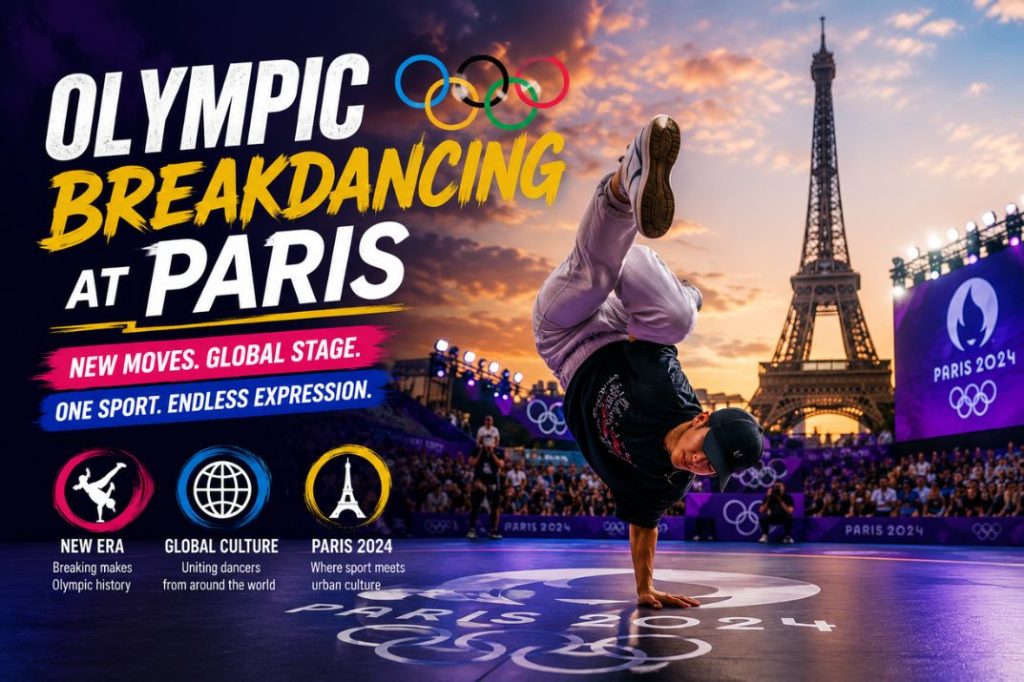
The Olympic Games have always changed with the times. New sports have been introduced, older events have evolved, and the way athletes compete has continued to develop. But few additions attracted as much curiosity as Olympic breakdancing at Paris 2024.
Officially known as breaking, the sport made its Olympic debut in Paris. It brought something noticeably different to the Games: street culture, music, improvisation, individual style, and athletic movement all came together in one competition. The International Olympic Committee had already featured breaking in the Youth Olympic Games before bringing it to the senior Olympic programme in Paris.
For many viewers, breaking represented more than another medal event. It showed how the Olympics are trying to connect with younger audiences and reflect the changing culture of international sport.
What Is Olympic Breakdancing?
Breaking is a competitive dance sport that developed from hip-hop culture.
Rather than following a fixed routine, athletes compete through a combination of movement, rhythm, creativity, technique, and improvisation. Competitors known as B-boys and B-girls perform individually while responding to their opponents and the music.
That makes breaking different from many traditional Olympic sports.
There is no ball, racquet, swimming pool, or running track. Instead, the athlete’s body becomes the main instrument of competition.
How Is Breaking Judged?
Breaking involves several elements that judges consider when comparing performances.
These include:
- Musicality
- Creativity
- Technique
- Execution
- Variety
- Personality
- Difficulty
- Overall performance
Athletes perform moves ranging from intricate footwork to powerful spins, freezes, and acrobatic movements.
The result is a competition that can look very different from one round to another.
Why Was Breaking Added to Paris 2024?
The inclusion of breaking reflected a wider attempt to make the Olympic programme more relevant to contemporary audiences.
The Olympics have increasingly experimented with sports and disciplines that have strong youth appeal. Skateboarding, sport climbing and BMX freestyle were among the newer additions around the Tokyo and Paris cycles, while breaking joined them at Paris 2024. The Olympic Qualifier Series for Paris also combined competition with a festival atmosphere involving music, art and culture.
Breaking fitted naturally into that direction.
It is already connected to a global culture with its own music, fashion, communities and competitions. Bringing it into the Olympics gave athletes from that world an opportunity to compete on one of the biggest sporting stages.
Paris 2024 Sports and the Changing Olympic Identity
Paris 2024 demonstrated that the modern Olympic programme is not simply about preserving traditional events.
The Games still featured athletics, swimming, gymnastics, fencing and many other established sports. At the same time, newer disciplines helped create a different atmosphere around the competition.
Breaking was particularly distinctive because it came from a cultural movement rather than a conventional organised sporting tradition.
From Street Culture to the Olympic Stage
Breaking began as part of the hip-hop movement and developed through communities, battles and local scenes.
Its Olympic appearance therefore represented a remarkable journey.
Something that grew through streets, clubs and community gatherings was suddenly being watched by a worldwide Olympic audience.
That transition was not without debate. Some people questioned whether breaking belonged in the Olympics at all, while others saw its inclusion as evidence that the Games could evolve without losing their competitive spirit.
What Made Breaking Different at Paris 2024?
One of the most interesting aspects of breaking was the atmosphere.
Traditional Olympic events often depend heavily on established competition structures. Breaking had a different visual and musical identity.
The athletes interacted with the music and each other while performing.
Every round could therefore feel unpredictable.
Creativity Was Part of the Competition
In many sports, athletes try to reproduce a technically perfect performance.
Breaking adds another dimension.
Two athletes may perform movements of similar difficulty, but their creativity, timing, musical interpretation and personality can influence how the performance is perceived by judges.
That makes the sport especially interesting for audiences who enjoy individuality rather than simply measuring speed, distance or time.
The Role of Music and Culture
Music is central to breaking.
Unlike many Olympic sports where music is simply background entertainment, the relationship between music and movement is part of the performance itself.
The athlete has to listen, react and adapt.
This connection also helped distinguish breaking from other events on the Paris 2024 programme.
It was not simply about physical ability. Culture was visibly part of the competition.
Why Modern Olympic Events Matter
The addition of breaking raises a larger question: what should the Olympic Games look like in the future?
The Olympic programme has never remained completely fixed.
Sports are added, removed, modified and reorganised as the Games evolve.
The IOC’s own Olympic programme materials describe this as part of the programme’s rejuvenation process, particularly through newer sports and youth-oriented disciplines.
Modern Olympic events can therefore serve several purposes.
They can:
- Attract younger audiences
- Introduce different sporting cultures
- Create new opportunities for athletes
- Increase social-media interest
- Make the Games more diverse
- Connect the Olympics with contemporary culture
Breaking demonstrated many of these possibilities at once.
Will Olympic Breakdancing Return?
This is where the story becomes particularly interesting.
Breaking was included specifically for Paris 2024, but it is not part of the sports programme announced for Los Angeles 2028.
Instead, LA28 has added baseball/softball, cricket, flag football, lacrosse and squash to its programme.
That means the Paris appearance of breaking was significant even if it does not immediately become a permanent Olympic fixture.
Its future could depend on several factors, including international participation, audience interest, the development of the sport and decisions surrounding future Olympic programmes.
The Future of Modern Olympic Events
Breaking’s Olympic debut highlighted an important reality: the Olympic Games are competing for attention in a very different media environment from previous generations.
Young audiences consume sports through short videos, social platforms, streaming services and creator-driven content.
Newer sports can fit naturally into that environment.
The challenge for the Olympics is finding the right balance.
Traditional sports carry history and global recognition. Newer disciplines can provide freshness and cultural relevance.
The future Olympic programme will likely continue experimenting with that balance.
Paris 2024’s Lasting Impact on Sports
Even beyond the medals, Paris 2024 gave breaking a level of exposure that few competitions could match.
Athletes who had spent years developing their craft were suddenly competing under the Olympic spotlight.
The event also introduced millions of viewers to a sport they may never have encountered before.
That is one of the unique powers of the Olympics.
A single appearance can introduce an entire sporting culture to a completely new audience.
Frequently Asked Questions
Yes. Breaking, commonly called breakdancing, made its Olympic debut at Paris 2024.
The official Olympic name for the sport is breaking. Competitors are generally referred to as B-boys and B-girls.
Breaking performances are evaluated using factors such as technique, creativity, musicality, execution, variety and overall performance.
Breaking was part of the Olympic movement’s effort to introduce newer, youth-oriented sports and connect the Games with contemporary sporting and cultural trends.
No. Breaking is not included in the current Los Angeles 2028 Olympic sports programme. LA28 instead added sports including cricket, flag football, lacrosse, squash and baseball/softball.
Breaking originated as a dance form within hip-hop culture but has developed into a competitive discipline involving athletic ability, technique, creativity and judging.
Recent Olympic programmes have included sports and disciplines such as skateboarding, sport climbing, BMX freestyle and breaking, reflecting efforts to refresh the Olympic programme.
Modern events can help the Olympics reach younger audiences, represent different sporting cultures and keep the Games relevant as sports and entertainment continue to evolve.
Conclusion
Olympic breakdancing at Paris 2024 was more than an unusual addition to the Olympic schedule. It represented a changing relationship between sport, culture and entertainment.
Breaking brought hip-hop culture, music, athletic ability and individual creativity onto the Olympic stage. Its inclusion also demonstrated how Paris 2024 sports reflected the broader evolution of modern Olympic events.
Although breaking is not currently scheduled for Los Angeles 2028, its Paris appearance has already become part of Olympic history.
The bigger question is not simply whether breaking returns.
It is whether the Olympics will continue opening their doors to sports that look, sound and feel different from the traditional programme.
If Paris 2024 showed anything, it is that the Olympic Games are still capable of changing with the world around them.